Homogenization & multiscale media
Rigorous derivation of macroscopic equations from PDEs posed in complex, periodic, and evolving microscopic geometries.
Overview
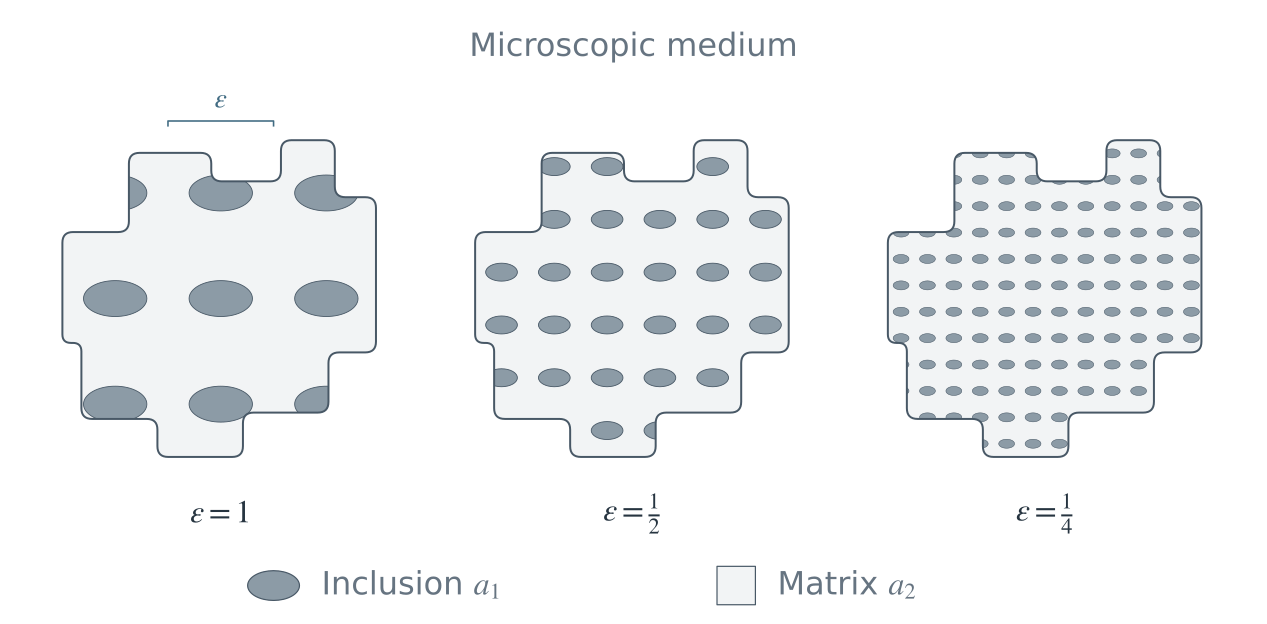
Homogenization studies equations in materials with very fine spatial structures and derives effective macroscopic models that retain the essential influence of those structures. A material with a very small, but positive, characteristic length scale \(\varepsilon\) can be approximated by a homogeneous substitute material: by artificially letting \(\varepsilon\to0\), one derives effective equations for the original medium without resolving each microscopic detail. My research focuses in particular on media with time-evolving geometries and on metamaterials, including effective transport, fluid flow, and electromagnetic properties.
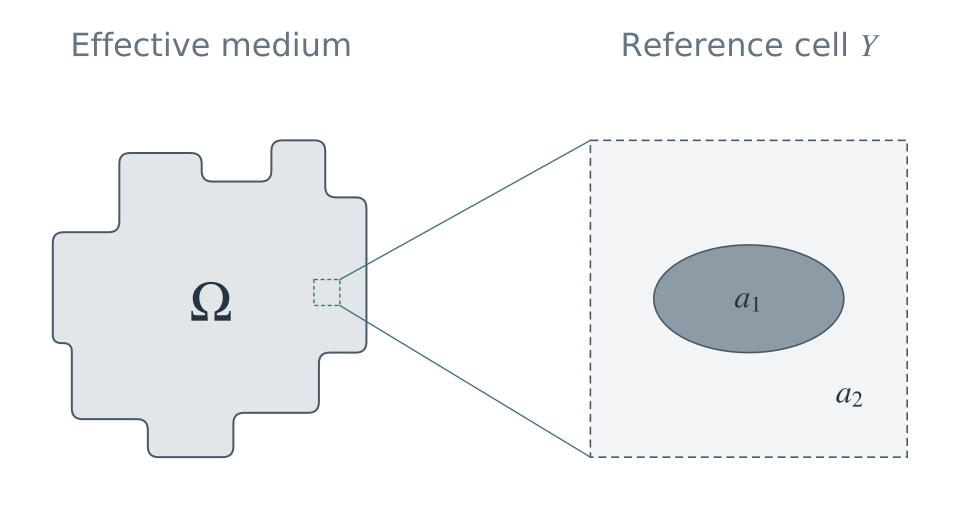
A fundamental example is periodic homogenization of a stationary elliptic conductivity problem. The material consists of two components with different conductivities, periodically arranged on the small length scale \(\varepsilon\). Although the physical material has a fixed, small \(\varepsilon>0\), we consider the idealized limit \(\varepsilon\to0\) to obtain a homogeneous substitute material. Its effective conductivity is described by the constant tensor \(A^{\mathrm{hom}}\), which incorporates the influence of the unresolved microscopic phases.
Microscopic equation
Effective equation
Effective coefficient
Cell problem
The cell correctors \(\chi_j\) capture how the periodic microstructure distorts a unit macroscopic gradient in direction \(e_j\). Averaging the resulting microscopic flux over one unit cell yields \(A^{\mathrm{hom}}\). In general, this tensor is anisotropic, even when the local conductivity \(a(y)\) is a scalar. This stationary example illustrates the basic mechanism underlying more elaborate homogenization problems, including evolving microstructures, fluid flow, and effective interface conditions.